TILL RELAY SLOT GUIDES
 Partner advertising · Great BritainUpdated 16 November 2026
#1Partner offer #2Partner offer #3Partner offer
Real money casino games in Great Britain: what changes by rule, not by feel
Partner advertising · Great BritainUpdated 16 November 2026Advertisement · 18+. Bonus amounts, ratings and review counts are campaign-supplied figures, not independently verified reviews. This placement does not confirm a British gambling licence. Check local eligibility, availability and current terms with the operator.



Moving to real money casino games changes four concrete things on a Gambling Commission licensed site: you are identity-checked before you can play at all, every stake is taken from your own balance at the moment the round starts, every round is written to a record you can ask for, and the money sitting in the account stays yours even if you close it. Nothing about the maths of a game changes. What changes is who is on the hook for the money and what paperwork exists afterwards.

-
 Play’n GO
Reactoonz
Clusters and cascades
-
 Play’n GO
Fire Joker
Fixed lines
-
 Play’n GO
Legacy of Dead
Expanding symbols
-
 Pragmatic Play
5 Lions Megaways
Variable ways · High volatility
-
 Pragmatic Play
John Hunter and the Tomb of the Scarab Queen
Collection features
-
 Push Gaming
Razor Shark
Mystery reels · High volatility
Published RTP 96.70% / 94.06%
-
 Push Gaming
Fat Rabbit
Collection features · High volatility
Published RTP 96.45% / 94.15%
-
 Relax Gaming
Snake Arena
Chase features
Published RTP 96.25%
-
 BGaming
Golden Paw: Hold & Win
Hold & Win · Medium volatility
Published RTP 97%
-
 NetEnt
Twin Spin
Linked reels · Medium volatility
Published RTP 96.55% / 96.06%


Demo and real money are the same game with a different ledger
A demo version of a slot runs the same software as the paid version. The reels use the same symbol set, the same maths model and, on a properly configured site, the same published return. What differs is the ledger behind the spin. In demo the credit counter is a number with no owner. In real play the counter is a liability the operator owes you, recorded against your account, reportable to the regulator and recoverable by you.
That sounds abstract until something goes wrong. A demo round that disconnects is simply gone — nobody owes anybody a result. A real round that disconnects has to be resolved, because there is a stake in it. Great Britain's remote technical standards cover exactly this case, and the rule is not "the operator decides": an interrupted round has to be completed or voided and the stake returned when you come back. What matters is that you note the game, the time and the round identifier while the screen is still in front of you.
The second difference is that bonus terms only attach to real money. A demo balance has no wagering requirement, no maximum bet, no game weighting and no maximum cashout, because there is nothing to withdraw. The moment you deposit into an offer, every one of those conditions starts applying to the balance, and in most cashiers the bonus funds and your own cash are tracked separately. Read which pot a spin is drawing from before you decide a session went badly.
Demo play is good for one thing: learning where the buttons are. It will not show you the parts of the product that only exist around real money — the verification step, the deposit limit prompt, the withdrawal queue, the document request. Those are the parts people get stuck on, and they are the parts you cannot rehearse.
You are checked before the first spin, not after the first win
This is the single biggest practical difference between a British licensed site and the offshore ones that turn up in search results. A licensed operator here has to verify your name, address and date of birth before it lets you deposit or gamble — and that duty runs to free-to-play games on the same site too. In other words, on a properly run GB site the identity check sits in front of everything, including the demo lobby. It is not a hurdle the cashier springs on you after a win.
What actually happens: you give your name, date of birth and address, and the operator matches that against third-party data. Most accounts clear electronically in seconds and you never see a document request. When the match fails, the usual culprits are mundane — a recent house move, a name that differs from the one on the electoral roll, a flat number written differently, a middle name included on one record and not another. That is when you get asked for a photo ID and a recent proof of address.
Why the name on the card has to match
Payment details are checked against the account holder, not just against the card. A debit card in a partner's name, a joint account where the primary holder is someone else, a card registered to a previous address: each of these can pass a deposit and then fail at withdrawal, because a withdrawal is where the operator has to prove it is paying the right person. If the names do not match exactly, fix it before you deposit rather than after. The same logic sits behind a card payment that sits pending — the money has moved, but the ownership question has not been settled yet.
Keep whatever you upload. Dated screenshots of the document you sent, the date you sent it and the reference the operator gave you are worth more later than your memory of the conversation. If a payout is ever queried, that record is the whole of your case.
How a stake is counted and what the published return describes
The stake comes off your balance when the round starts, not when it ends. On a slot that means at the moment the reels begin to move; on a table game at the moment the bet is confirmed. This matters for two reasons. First, a round that is in progress has already cost you, which is why interrupted-round rules exist. Second, a feature bought with a bonus-buy button is a stake like any other, usually a large multiple of the base bet, and it is taken in one go.
The percentage printed in a game's information screen describes the long-run return of that game version over an enormous number of results. It is not a session forecast, and it is not a promise about your next hundred spins. It is also version-specific: the same title can ship with more than one configured return, and the figure that applies is the one shown inside the game you have actually opened. Our slot rules and features library lists the published figures game by game, and the point of listing them is that you check the one in front of you rather than one you read elsewhere.
A worked example, with made-up numbers
The figures below are an illustration, not anyone's real session and not any operator's data. Suppose you set a spin at £0.20 and play 500 spins. Your total staked is £100 — and that is the figure a casino means by "turnover". Your net position is not £100 minus the published return; it is whatever the 500 individual results happened to add up to, which can easily be nothing back or several times the stake. The published return describes the average of millions of spins, so over 500 it tells you almost nothing. What it does tell you reliably is that turnover and loss are different numbers, and that wagering requirements are written against turnover.
| Stake per round | Rounds played | Total turnover | What this figure is used for |
|---|---|---|---|
| £0.20 | 500 | £100 | Wagering progress, loyalty points, deposit-limit reporting |
| £2.00 | 50 | £100 | The same turnover from one twentieth of the rounds |
| £0.20 | 50 | £10 | The same rounds at one tenth of the turnover |
Read the table the other way round and you have the one honest lever you control: stake size and number of rounds, nothing else. A bonus that needs a given turnover can be met with many small rounds or few large ones, and the two routes expose you to completely different swings.
Real money casino games you will actually meet, and what each one charges
The four families below cover almost everything in a British casino lobby. None of them is "better value" in a way you can bank on, but they charge you in structurally different ways, and knowing the structure is more use than any percentage you half-remember.
| Game family | What one stake buys | Where the edge is built in | What to read before you play |
|---|---|---|---|
| Online slots | One resolution of the reel set | The symbol weighting and the paytable | Paytable, feature triggers and the published return for that version |
| Roulette | One spin at the stated odds | The zero pockets: a single-zero wheel has 37 and a double-zero wheel 38, while a straight-up number still pays 35 to 1 | Which wheel the table uses, and any side-bet rules |
| Blackjack | One hand against the dealer | You act first and can bust before the dealer plays; the rules on dealer draws and doubling vary by table | The payout for a blackjack and the dealer rules printed on the felt — they are not identical at every table |
| Live dealer tables | One hand or spin on a streamed table | The same structure as the equivalent RNG game, plus table minimums | Table limits, the side bets offered, and what happens to a bet if the stream drops |
Two things on that table deserve spelling out. A single-zero roulette wheel is structurally kinder than a double-zero one for the same bet, and that is a fact about the wheel, not a promotion. And a blackjack payout is not a constant: the figure on the felt is part of the product, and two tables in the same lobby can differ. Neither observation is a system for winning, because none exists. They are simply the two places in a lobby where reading beats guessing.
British online slots also carry design rules that demo play on an unlicensed site will not show you: no autoplay, no spin that completes faster than two and a half seconds, no feature that dresses a return below your stake up as a win, and no celebratory sound for a result that gave you back less than you put in. If a slot you are playing behaves otherwise, you are not on a site licensed here.
Deposits: debit yes, credit no
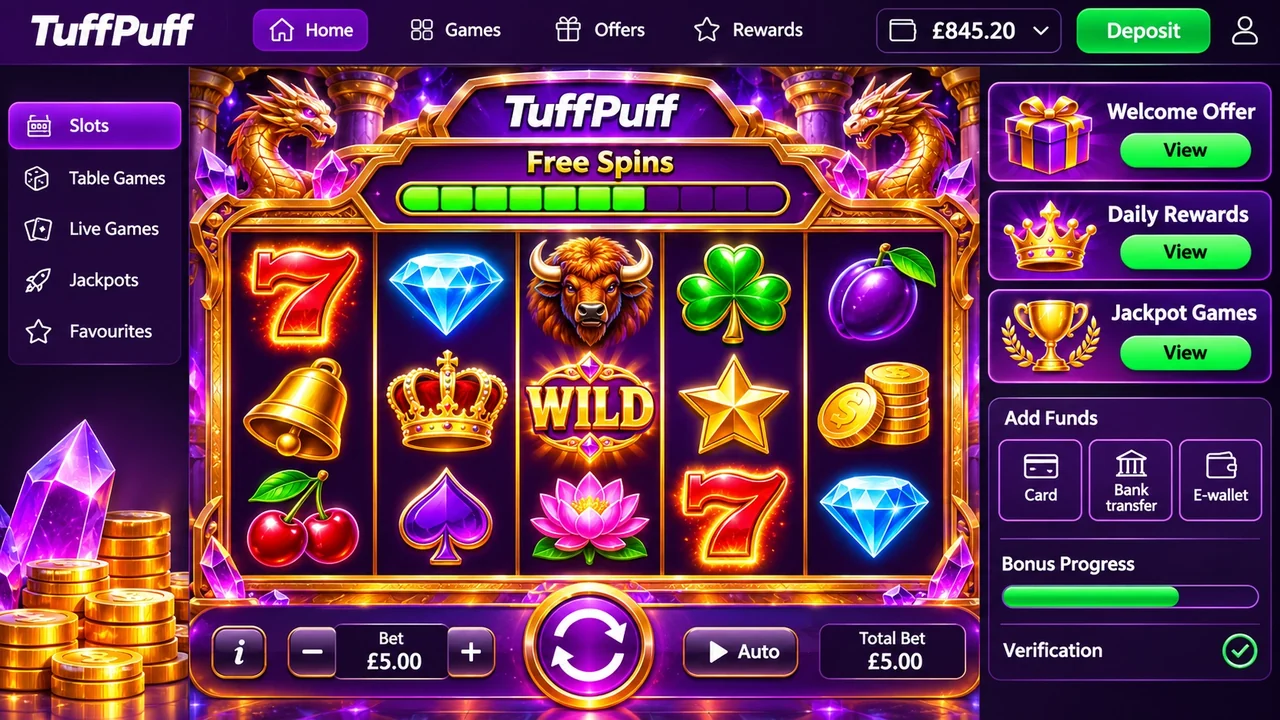
Credit cards cannot be used to fund online gambling in Great Britain. That is a straight prohibition on licensed operators, not an operator preference, and it applies however the card is dressed up — a credit card inside a digital wallet is still a credit card, and an e-wallet funded from a credit line is caught by the same intent. If a cashier accepts a credit card from a British address, that tells you something about the site, not about your luck.
What is left is the sensible stuff: a debit card, an open-banking payment straight from your account, a prepaid product, or an e-wallet funded from a bank account. Each has a different failure mode. Card deposits can fall over at the 3-D Secure step and leave an authorisation showing on your statement that is not a completed payment. Bank-to-bank payments can fail simply because your bank is not on the cashier's list. Prepaid vouchers often deposit happily and then cannot receive a withdrawal at all, which is a problem you create for yourself at deposit time.
The method you deposit with usually decides how you get paid
Operators generally return money to the source it came from, as far as that is possible. If you funded the account from three different places, the cashier may split a payout across them, and it will normally work through them in the order and proportion its rules set rather than the one you would pick. That is also why a balance built up from several deposits can behave oddly on the way out: see how a net-deposit balance changes the withdrawal method for the mechanics. The practical rule is dull and effective — deposit with the method you want to be paid back to, in your own name, and keep it that way.
Every real round leaves a record, and you can ask for it
This is the part of real money play that most people never use and then badly need once. Each round you play has an identifier attached to it, and the operator holds the result against it: the stake, the outcome, the time, the game version. When a result looks wrong — a feature that did not pay what the paytable says, a win that appeared and then vanished, a round that never resolved — the identifier is what turns an argument into a checkable question.
Finding it is usually easier than people expect: most games display it somewhere in the round history or game information panel, and it is in your account history afterwards. Finding the round ID for a missing result walks through where to look in the common layouts. Capture it before you close the game, because the in-game history is the shortest-lived copy.
What happens to the balance when you close the account
Closing an account does not forfeit the money in it. The balance is yours, and an operator that is shutting an account down is expected to return it to you by a verified method. In practice there are three sequences, and they behave differently.
- You close the account yourself. Request the withdrawal first and let it complete, then close. Closing with funds in place usually works too, but it puts your payout behind an account-closure process instead of in front of it.
- The operator closes it. You should still be paid the cash balance. Bonus funds and unconverted bonus winnings are a different matter: they are the operator's money until the conditions attached to them are met, and the terms that applied when you accepted the offer are the ones that decide.
- The account goes dormant. A long-unused account can be suspended and the balance put aside rather than lost. You will need to get through verification again to claim it, which is far easier if the address and card on file are still current.
One avoidable mistake sits across all three: cancelling a withdrawal and sending it back into play. A pending withdrawal that you reverse is not a neutral act — the money re-enters the balance and is exposed again, and on some sites it also resets whatever position you had in the payout queue. If you have asked to be paid, let it be paid.

What to check before the first deposit
Ten minutes before, rather than three weeks after. None of these needs a deposit to answer, and each one has caught somebody out.
- The licence. A site licensed to serve Great Britain says so and names the licensee company; the Gambling Commission publishes a public register you can check that name against. A badge image on its own proves nothing.
- The withdrawal tab, not the deposit tab. Confirm the method you intend to be paid by is listed as a withdrawal option for your account and your currency.
- The name match. Account name, card name and address on the statement should be identical. Fix a mismatch now.
- The bonus conditions, as numbers. Wagering multiple, maximum stake while wagering, game weighting, maximum cashout, expiry. If any of those is not written down, treat it as a reason to decline the offer.
- The deposit limit tools. Set the limit you want on day one, while the number is a decision rather than a reaction.
- The withdrawal caps. Daily, weekly and monthly limits do not stop you being paid; they decide how long being paid takes.
- The complaint route. Find the operator's complaints page and the alternative dispute resolution provider named on it before you need either.
The honest summary of that list: nearly every dispute that lands on our desk could have been avoided at step three or step four.
When the operator says no
Complaints about real money casino games follow a fixed order in Great Britain, and skipping a step wastes weeks. You complain to the operator first, in writing, through its complaints process. If it cannot be resolved there, the operator has to tell you about an alternative dispute resolution provider approved for its licence, and that provider will look at the case for free. Our guide to taking an unresolved dispute to ADR covers what the provider will and will not look at.
What the Gambling Commission does not do is adjudicate your individual payout. It regulates the operator, it acts on patterns of behaviour and it can sanction a licensee, and reporting a problem to it is genuinely useful — but it will not order a casino to pay you a specific sum. Knowing that in advance saves you aiming the first letter at the wrong address.
Write the complaint around facts: dates, amounts, round identifiers, the exact wording of the term you say was misapplied, and what you want done. That is the same evidence the ADR provider will ask for later.
Real money casino games are for adults of 18 and over. Decide the amount before you open the cashier, set your deposit limit when you open the account, and if gambling has stopped being something you choose, support is available.
Questions people ask about real money casino games
Are the odds different in demo mode and real money play?
On a properly configured licensed site, no: the demo runs the same maths model as the paid game. What differs is the ledger. A demo balance is a display number with no owner, while a real balance is money the operator owes you and has to account for.
Why am I asked for ID before I have deposited anything?
Because that is the order Great Britain requires. A licensed operator must verify name, address and date of birth before you deposit or gamble, and that duty extends to free-to-play games on the same site. A site that lets you play first and asks questions after a win is not following GB rules.
Can I use a credit card for a casino deposit in Great Britain?
No. Credit cards are prohibited for online gambling here, including a credit card held inside a digital wallet. Use a debit card, an open-banking payment from your account, or an e-wallet funded from a bank account.
Does the published return percentage tell me what I will get back?
No. It describes the long-run average of that game version over an enormous number of results, and it is version-specific. Over a few hundred spins it predicts nothing useful. Check the figure inside the game you have opened rather than relying on one quoted elsewhere.
What happens to my money if I close my casino account?
The cash balance stays yours and should be returned to a verified payment method. Bonus funds and winnings still subject to unmet conditions are governed by the terms you accepted. The cleanest sequence is to withdraw first, confirm the payment, then close.
A round crashed halfway through. Who owes me the stake?
The operator has to resolve it: the round is either completed or voided with the stake returned. Note the game, the time and the round identifier before you close anything, then ask support to resolve that specific round rather than describing the problem in general terms.